
New England Utility Constructors (Neuco) builds and maintains underground gas and electric systems for utilities across New England. Its field reporting, approvals and billing ran on paper forms and disconnected spreadsheets, and invoices took one to three months to produce. Keene Systems built a custom web and mobile platform that unified the whole process, from the foreman in the field to the invoice. Billing now takes five days.
About Neuco
 Neuco is an underground utility construction firm that has served as a turnkey partner to gas and electric distribution utilities since 1972. It is headquartered in Lawrence, Massachusetts, with locations in Maine and New Hampshire, and is part of Centuri. Its customers are gas and electric distribution utilities, local distribution companies, municipal utilities and master meter operators.
On any given day Neuco has more than 500 employees and 80 crews in the field doing:
- Natural gas main and service installation and replacement
- Underground electric infrastructure
- Water work
- Welding fabrication
- Street restoration: milling, paving and concrete work
- Horizontal directional drilling
- Cast iron encapsulation
- Saw cutting and trench grinding
- Vacuum excavation
The business problem
Neuco was growing quickly, and the way it recorded and billed its work could not keep up. Every step depended on paper and on people retyping what someone else had already written down:
- Each foreman filled out a two-sided paper form describing what the crew did that day.
- The form went to the main office, where someone typed it into spreadsheets. The same data often had to be entered into more than one.
- The spreadsheet data then had to be deciphered and refined, a job only two or three key people knew how to do.
- Another person re-entered the result into the accounting system so the work could be billed.
- After that, the data was entered yet again into the utility client’s own system.
The result was a billing cycle that stretched from one to three months, frequent errors, and very little visibility. Management had a hard time knowing what was happening on any given project, and reporting across projects was close to impossible because the data was spread over so many files.
Key pain points
- Delayed billing and cash flow caused by manual workflows
- No real-time view of field work or approvals
- High-value business data trapped in error-prone, disconnected Excel spreadsheets
- Difficulty integrating with existing systems
- Inefficient equipment and asset tracking and maintenance
Why off-the-shelf software could not solve it
Neuco had tried more than once to implement packaged ERP and CRM products. Each attempt failed, because the products did not fit the way Neuco works. The core reason is that Neuco’s billing requirements are dictated by its clients. Each utility contract spells out its own rules for what is billable and how it is calculated, so no general-purpose product could follow them. That mismatch had become a barrier to growth and to taking on new business.
The spreadsheets were a symptom of the same gap. When packaged software does not fit, capable employees build their own solutions with the tools they know. Those solutions work while the data is small. As the company grows they become harder to maintain, harder to report from and dependent on the few people who understand them. That is what had happened at Neuco. See when off-the-shelf software does not fit and outgrowing spreadsheets.
Our approach: the business first, then the software
Neuco did not just need new software. It needed a system designed around its business. Keene Systems proposed a custom web application with mobile capability, built on Microsoft ASP.NET and SQL Server, and started with the process, not the code.
- Document how the company really operates. Our business analyst met frequently with Neuco to record exactly how the company worked and, more importantly, how it wanted to work.
- Capture the rules. There were hundreds of business rules that only a few employees carried in their heads, many of them written into complex client contracts. All of them were drawn out and recorded in a Functional Requirements Document, the blueprint for the programmers.
- Design screens alongside the rules. Data entry screens were mocked up while each rule was still fresh, so the people who would use them could react early.
- Build in two-week sprints. The work was delivered in small Agile increments, so Neuco saw working software regularly and could steer it.
- Design the database for the future. A flexible data architecture was built to support any kind of reporting and to let the system expand.
This is the same discipline as sitting down with an architect before building a house. It is described in our guide, How to Plan a Software Project.
The platform we built
The result is a single, end-to-end platform that manages people, materials, equipment, projects, subcontractors, clients, invoicing and reporting.
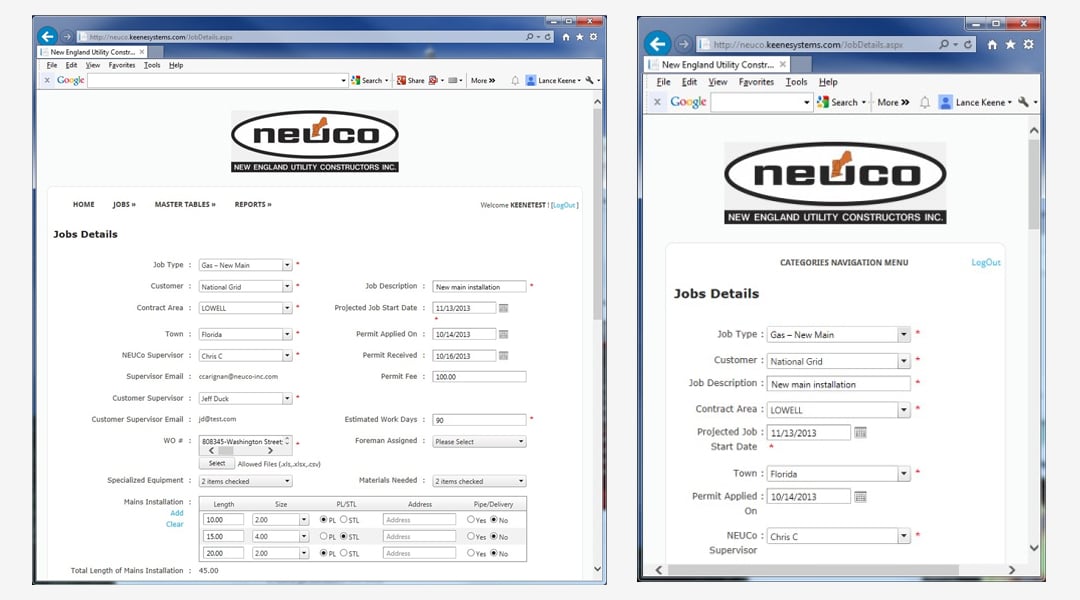
- Mobile field data capture. Foremen record the day’s work on a tablet or phone as it happens. Screens reconfigure themselves for the device, and entries sync with the office.
- Contract rules applied at entry. The system asks the right questions and applies the right calculations for each job. Foremen and supervisors do not need to know what a given contract says.
- Validation and managed approvals. Entries are checked as they are made, and work moves through a defined approval flow that everyone can see.
- Project costing with profit and loss. Management sees what each project is costing and earning while it is still under way.
- Equipment and asset tracking. Equipment use, rentals and performance are tracked and reported.
- One-click invoicing. Invoices are generated from the approved field data and emailed to the client automatically.
- Dashboards and reporting. Revenue and asset dashboards, drill-down reports and analysis across projects answer questions that could not be answered before.
- Excel import and export. Large volumes of records can be uploaded and downloaded when a spreadsheet is still the right tool.
Technology and integrations
- Application: Microsoft ASP.NET and C#, with Telerik controls for the user interface
- Database: Microsoft SQL Server
- Integrations: SAP ERP and Neuco’s other existing systems, connected through APIs
- Reporting: Power BI reports alongside the platform’s own reporting
- Field use: smartphones and tablets, designed to keep working where coverage is poor
See also connecting your software to outside systems and getting data from field and remote teams.
Results
The first release shortened the billing cycle from seven weeks to three. With field data captured once and invoices produced directly from it, the cycle is now five days, down from as long as three months.
These figures reflect results for this client in its own operating context. Results vary from project to project.
- Foremen enter data in the field and record activities as they happen.
- Validation on every entry prevents errors at the source.
- Billing can start as soon as a project is complete, instead of after weeks of tabulation.
- Management can produce up-to-the-minute reports on every project, and reports that combine data across projects.
- Decisions are made on current, dependable numbers, which gives Neuco a real competitive edge.
A long-term partnership
Keene Systems has worked with Neuco for more than a decade, and it is one of our largest and longest-running client relationships. The platform has grown with the company: new modules, new integrations and new reporting have been added as the business and its clients’ requirements changed. The same team that built the system continues to develop it.
Frequently asked questions
What did Keene Systems build for Neuco?
A custom web and mobile platform that brings field data capture, approvals, project costing, equipment and asset tracking, reporting and invoicing into one system. It replaced two-sided paper foreman reports and a set of disconnected Excel spreadsheets.
Why did off-the-shelf software not work for Neuco?
Neuco’s billing requirements are set by its utility clients and written into each contract, so the rules differ from client to client and job to job. Several attempts to adopt packaged ERP and CRM products failed because those products could not follow Neuco’s workflows.
How much faster is Neuco’s billing now?
Billing used to take one to three months from the end of a job. With field data entered once and invoices generated from it in one click, the billing cycle is now five days.
What technology does the Neuco platform use?
It is built on Microsoft ASP.NET with C#, Telerik controls and a SQL Server database. It exchanges data with SAP ERP and Neuco’s other systems through APIs and feeds Power BI reports.
Can field crews use the system without a reliable connection?
Yes. Foremen enter their reports on phones and tablets, and the platform is designed to keep working in places with poor coverage and to sync with the office when a connection is available.
Running field work or billing on paper and spreadsheets? Schedule a project exploration call or use the form at the bottom of this page. Related problems we solve: replacing paper forms, complex billing and invoicing and management dashboards and visibility.

Contact Us
for a free consultation