
Oklahoma City, OK .NET Development Company
Custom .NET software for companies in Oklahoma City and central Oklahoma, including Edmond, Norman, Moore, Midwest City and Yukon.
Your Oklahoma City software works. It just won’t talk to anything built this decade.
Legacy business applications often fail quietly rather than dramatically. The old .NET or VB6 system still processes orders and tracks equipment, but it cannot connect to your new accounting package, your customers’ portals, or the mobile tools your crews want to use.
Keene Systems modernizes those applications on current Microsoft .NET, keeping the business rules that work and opening the door to the integrations and devices your Oklahoma City team needs now.
How we work with Oklahoma City companies
Keene Systems is based in New Hampshire and works with clients in Oklahoma City and central Oklahoma by video call and screen share. You meet the analysts and developers who build your system, see working software every two weeks, and own the code we write for you.
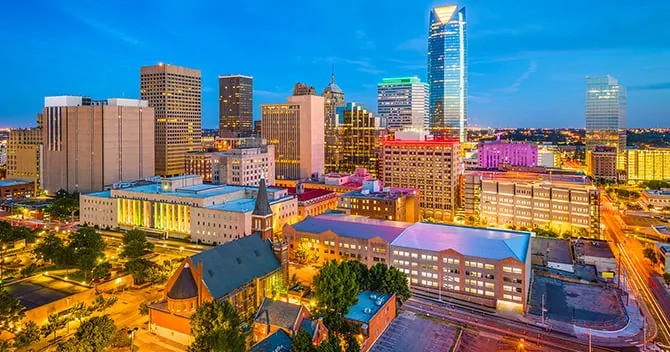
.NET modernization for Oklahoma City companies
We move older .NET Framework and VB6 code onto modern .NET with clean APIs, so your core system can exchange data with cloud services, partners, and mobile apps. The work happens in phases, with the old system running until each new piece is ready. Learn more about our .NET development services.
What we deliver on an Oklahoma City .NET modernization
- Mobile field app: tickets and logs captured on phones or tablets.
- API layer: clean connections for billing, accounting, and partners.
- Customer portal: operators see their own loads and tickets.
- Modern platform: core logic moved to current .NET.
- Phased rollout: changes delivered without stopping operations.
Oklahoma City energy-services firms, equipment dealers, and manufacturers often built solid custom software years ago and have relied on it ever since. Today their customers expect online ordering, their operators expect mobile field entry, and their accountants expect automatic data feeds, none of which the old architecture supports.
A modernized .NET application keeps what you trust and adds what you are missing: web access, APIs, and a platform Microsoft will support for years.
An Oklahoma City example
An illustrative scenario, drawn from the kinds of projects we handle. It is a composite, not a specific client.
Picture an Oklahoma City saltwater-disposal and water-hauling company that built a .NET dispatch and ticketing system years ago. It works, but drivers still bring paper tickets back to the office because the system has no mobile interface, and the accounting team re-keys every ticket into its billing software.
Modernizing on current .NET adds a mobile ticket app for drivers, an API for the billing system, and a customer portal for operators who want to see their loads. The dispatch logic the company refined over years stays intact.
Tickets reach billing the same day, and disputes with operators drop because both sides see the same records.
What changes after modernization
Paper disappears, billing speeds up, and customers get visibility they value. The company keeps the system it knows while gaining the connections modern operations require.
Getting paper out of the trucks
For a water-hauling and disposal company, the paper ticket is the start of every invoice. Adding a mobile app to the existing .NET system lets drivers capture loads, volumes, and signatures on a phone, even without coverage at remote sites. Tickets sync when the phone reconnects, and the office sees them the same day.
Billing becomes faster and more accurate because the data no longer passes through someone’s handwriting and typing. Disputes with operators drop because tickets include time stamps, locations, and signatures, and operators can see their own tickets through a portal.
Signs your Oklahoma City system can’t connect
- Field staff still use paper.
- Billing re-keys data from another system.
- Customers want visibility you cannot provide.
- Integrations require manual exports.
- The platform is aging.
The cost of a disconnected system
Paper tickets and re-keying delay invoices and invite errors, and every day of delay ties up cash. As volume grows, so does the cost. Connecting the system pays back quickly in faster billing.
We have modernized software for organizations as varied as NStar Electric and Gas, whose older application we re-engineered for secure internet access, and Centris Consulting, whose Access product became the web-based CView. In each case, years of business logic survived the move intact.
How we modernize an Oklahoma City system
We review the existing application and map the connections you need during the Business Analysis.
We modernize in phases, starting with the connection that saves the most time, and test each step with your team.
Questions Oklahoma City companies ask about .NET development
Can you add an API to our existing system without rewriting it?
Sometimes. If the code allows it, we can add integration points first and modernize the rest over time.
Will our field crews be able to use it on tablets?
Yes. Modern .NET web applications run on phones and tablets as well as desktops.
How do we avoid disrupting daily work?
Phased delivery and parallel running, so nothing switches over until it has been proven.
Can drivers capture tickets offline?
Yes, with sync when coverage returns.
Can operators sign tickets electronically?
Yes. The operator signs on screen, and the signed ticket is stored and ready to bill the same day.
Will it integrate with our billing software?
In most cases. Signed tickets can flow into the billing software through its API or an import file.
Can we keep the existing dispatch screens?
Yes, while modernizing underneath.
Can tickets include GPS locations?
Yes, captured automatically from the phone.
Can operators sign on the driver’s phone?
They can. The driver hands over the phone, the operator signs with a finger, and a copy is emailed on the spot.
Can dispatchers see tickets as soon as drivers submit them?
Yes. Once a phone reconnects, the ticket appears in the office system immediately, ready for review and billing.
What we love about Oklahoma City
We work with companies all over the country, and part of the pleasure is getting to know the places they call home. A few things people love about Oklahoma City:
- Bricktown: a warehouse district with a canal and water taxis.
- The National Cowboy and Western Heritage Museum: art and history of the American West.
- The Oklahoma City National Memorial: a quiet, moving place of remembrance.
- Scissortail Park: a big new park linking downtown to the river.
- The Boathouse District: rowing, kayaking and whitewater rafting on the Oklahoma River.
- Thunder basketball: a small-market team with a loud arena.
- The Paseo: a Spanish-style arts district of galleries and studios.
Service types
Oklahoma City systems ready for modern .NET
Older applications we often modernize in central Oklahoma:
- Energy services: field-ticket and equipment systems that need mobile access.
- Equipment dealers: parts and service applications that need online ordering.
- Manufacturing: production tools that must connect to new ERP systems.
- Agribusiness: inventory and contract systems ready for integration.
Why Keene Systems
Keene Systems is veteran-owned and has modernized business software since 1987. Every project can begin with a no-risk Business Analysis so you know the path and estimate in advance.
Want your old system to finally connect? Schedule a 20-minute project exploration call.
Schedule Your Oklahoma City, OK .NET Discovery Call