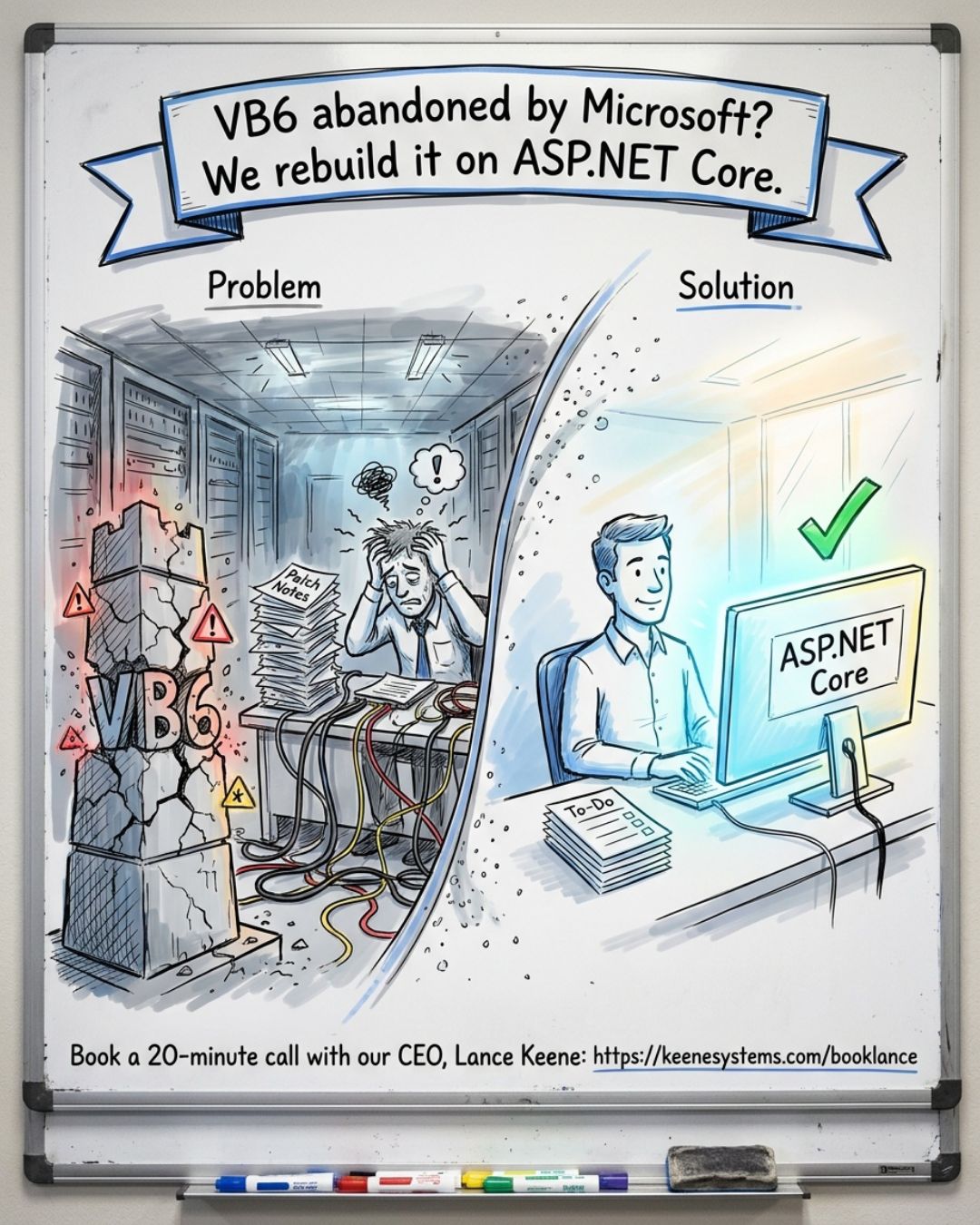
Your VB6 application still runs. But let’s be honest about what “runs” means these days.
Microsoft walked away from VB6 over a decade ago. Every fix you make now is a patch on a patch, built with tools nobody officially supports. Fewer developers will touch VB6 at any price, and the ones who do are reverse-engineering five layers of old workarounds just to understand what they’re changing. Each change gets riskier than the last — because nobody fully knows what the last patch was compensating for.
Then one day something breaks in production, and there’s no clean way to roll it back. That’s not a hypothetical. That’s the normal failure mode for systems like this. And every year that passes narrows the window to act safely, because the people who understand the system keep getting harder to find.
A rebuild in ASP.NET Core doesn’t make the problem disappear overnight — a rewrite is real work, and we won’t pretend otherwise. But it replaces fragile patchwork with a platform that still gets real security updates, real Microsoft support, and a deep bench of developers who can actually maintain it going forward.
If your business runs on VB6, the safest time to start planning the transition is before the next failure forces your hand, not after.
Book a 20-minute call with our CEO, Lance Keene: https://keenesystems.com/booklance